
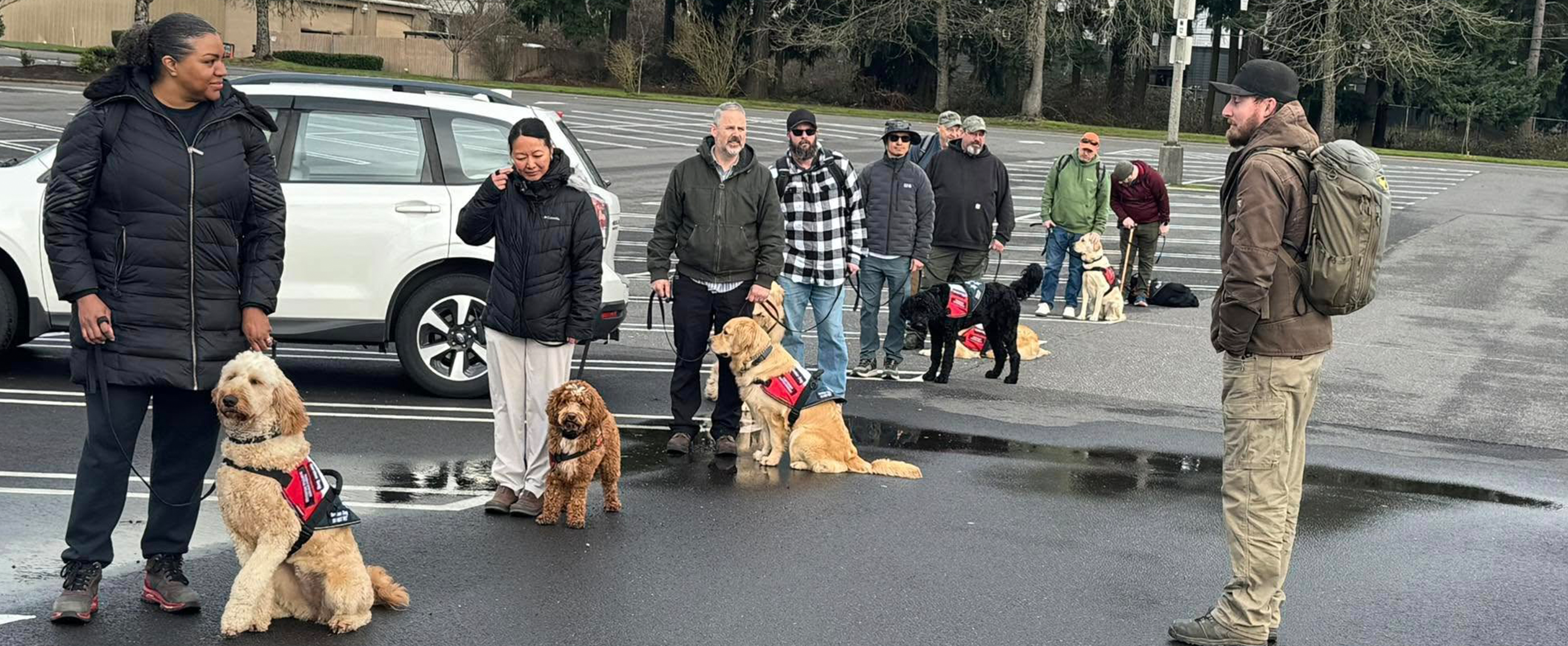
When a Veteran graduates from Northwest Battle Buddies (NWBB) with a professionally trained PTSD service dog, the partnership is just getting started.
Months of training have shaped the dog, and five weeks of handler instruction have prepared the Veteran. But keeping that team sharp in daily life takes ongoing work, and that's where recertification comes in.
We sat down with Jarod Walker, NWBB's Chief of Operations, to talk through the recertification protocol that brings Veteran-service dog teams back to headquarters on a regular schedule. The goal, he explained, is to catch bad habits early, protect the dog's health, and make sure every Veteran continues to get the most from their service dog throughout the dog's working life.
The National Model and the Five-Week Foundation
NWBB operates on what's known as a national model. The training team raises and trains each dog entirely before the Veteran ever meets them. By the time a service dog is paired with a handler, it has already learned the full range of public access behaviors and PTSD-specific tasks required to support its Veteran.
After pairing, Veterans spend five weeks at NWBB's facility for handler training. "They're not training the dog, they're learning how to maintain the dog," Jarod explained. The five-week course teaches Veterans how to read, lead, and care for their dog so the team's skills hold up in daily life.
There's a common saying in the dog world: a dog is only as good as its handler. Recertification exists because that saying never stops being true.
A Schedule Built to Catch Bad Habits Early
The first recertification happens three months after graduation. The second falls at nine months, which counts as the team's first annual recertification because it lands one year after they completed training. From there, recertifications are annual.
The early cadence is intentional. "If there are any bad muscle memory habits, we're identifying them at three months in versus letting them go for a whole year," Jarod said. "Some of those habits can be a lot harder to fight and break."
Each annual recertification also includes reviewing and resigning the team's contract. Over time, those signed contracts build a documented history that Veterans can show to employers, airlines, or other organizations when needed. "When they can show that documented history," Jarod said, "it just goes to show the level of caliber that they're at."
Inside a Recertification Session
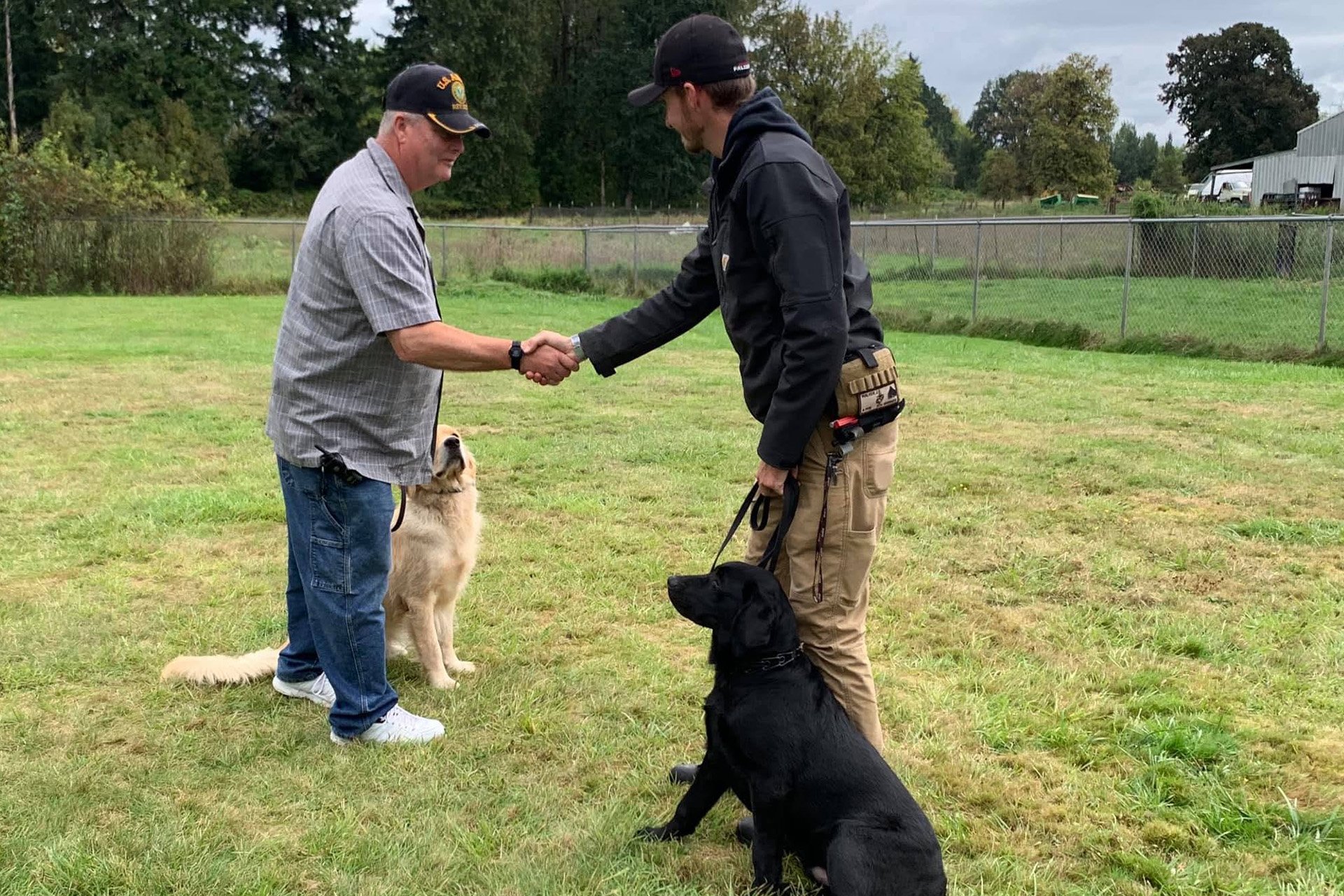
A typical session runs an hour and a half on the short end and can stretch to three hours if the Veteran has more to discuss. The flow stays consistent:
- Potty break and weight check: The dog gets a chance to relieve itself, then steps onto a full-size scale to confirm they’re within a five-pound window of their optimum weight.
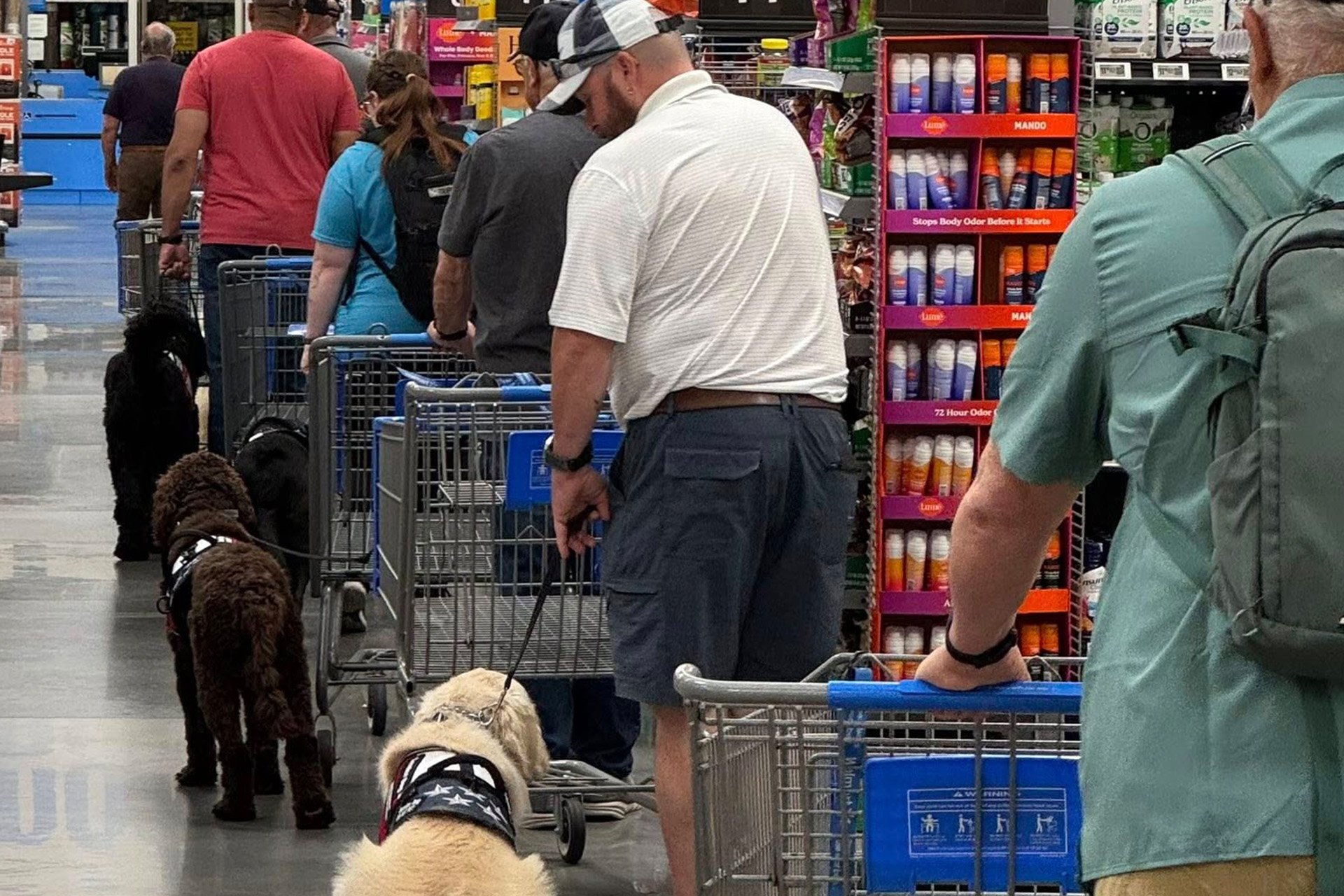
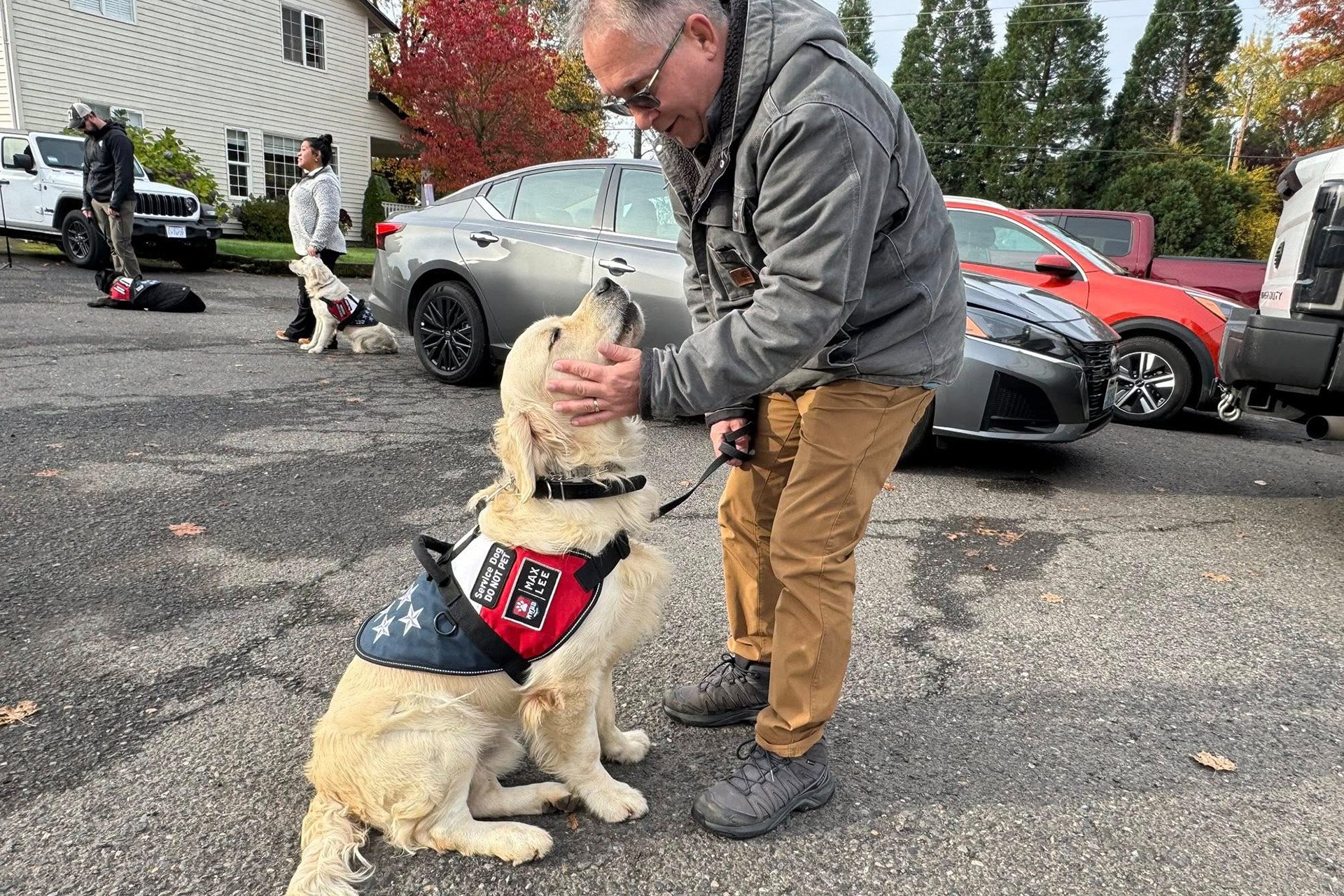
- Public test: The team heads to the local Walmart for laps around the store and a run-through of the checkout lines. Trainers also watch how the Veteran loads and unloads the dog from their vehicle.
- Food drop test: Trainers run a controlled test of the dog's response to food left within reach.
- Critique and debrief: Trainers discuss what they saw, answer questions, and give the Veteran a chance to share experiences with others in their cohort.
- Contract review: The Veteran reviews and resigns the team's contract.
The weight check carries real health stakes. With studies showing the toll excess weight takes on lifespan, joints, and organs, Jarod said NWBB has been "really harping on that." If a dog falls outside the five-pound window, NWBB places the team on a weight management protocol with monthly check-ins until the dog returns to a healthy range.
|
Recertification, training, and lifelong support all depend on sustained funding. Join Operation Never Quit with a monthly gift to help NWBB continue providing PTSD service dogs and care for the teams who depend on them. |
What Evaluators Are Watching For
Recertification isn't a memory test. Evaluators assess how Veterans handle their dogs in daily life, focusing on habits that have developed over months or years of real-world use.
"We want to see how they're handling their dog in daily life," Jarod said. "Ideally, they're doing the things that we taught during those five weeks, but people are going to modify things from time to time, and as long as it still works to where the dog is calm, controlled, and safe, we're still good with it."
Trainers watch for things like whether the dog is positioned safely in public, whether the Veteran is letting the dog forge too far ahead or keeping the leash tight from a bent arm, and whether obedience cues remain clear and intentional rather than complacent.
One habit NWBB emphasizes more than many other organizations is active protection of the dog in public, using a shopping cart or the handler's own body to shield the dog from foot traffic at checkouts. "In our opinion, it's not the public's responsibility to keep your dog safe," Jarod said. "It's the handler's responsibility to put the dog in a position where [an accident is] less likely to happen and they're more safe."
Flexibility for Long-Distance and Long-Term Teams
Most recertifications happen at NWBB's Washington headquarters, but the organization has expanded its options over time. Veterans who have completed their first annual can choose to recertify with Chris Walker in Tennessee, which eases the logistical load for teams on the East Coast. NWBB has also flown trainers out to recertify clusters of Veterans, including a group in Cody, Wyoming.
This year, NWBB introduced what Jarod calls the remote recertification protocol. Once a Veteran has completed three annual recertifications in person, they can complete the fourth and fifth by submitting video documentation of their handling to NWBB's Dropbox for trainer review. "It's been an effort to reduce some of that financial cost and the logistics of travel," Jarod said.
After a team successfully completes five annual recertifications and maintains good standing throughout, they become eligible for a final contract. From that point on, the team no longer needs to recertify in person for the rest of the dog's working life. Instead, they submit annual photos and weight documentation to confirm the dog is still with them, healthy, and at a stable weight.
When a Team Needs Extra Support
If a Veteran doesn't pass a recertification, it isn't treated as a failure. NWBB shares specific feedback on what shifted from the team's standard and schedules one-on-one time with trainers to help the Veteran and their dog get back to where they were at graduation. Sessions can be as short as an hour or as frequent as the Veteran wants, and trainers will keep working with the team for as long as they need.
"We know they're capable of doing it," Jarod said. "We wouldn't let you graduate if you weren't at that standard."
Veterans don't have to wait for a recertification to ask for help, either. NWBB's training line is open any time a Veteran has questions between annuals.
Stand With Veterans for the Long Haul
Recertification is one of the ways NWBB honors its responsibility to every Veteran and every service dog it places. The protocol protects the dog's health, sharpens the handler's habits, and gives the team documented proof of the work they continue to put in together.
If you're a Veteran living with PTSD, you can apply for a service dog at no cost. If you want to help sustain the training, pairing, and ongoing support that make these partnerships possible, join Operation Never Quit with a recurring gift, or explore other ways to get involved through Pledge-A-Pup, fostering a puppy, or donating gifts from our Amazon wishlist.